

AI Ticketing
Turn support issues into tickets that investigate themselves. ChatterMate raises a ticket from a chat (by the AI or an agent) or an incoming alert, auto-triages it, then runs an AI investigation that forms hypotheses, tests each one against your connected logs and databases, and writes a root-cause analysis with cited evidence — all in the open, with staged autonomy you decide.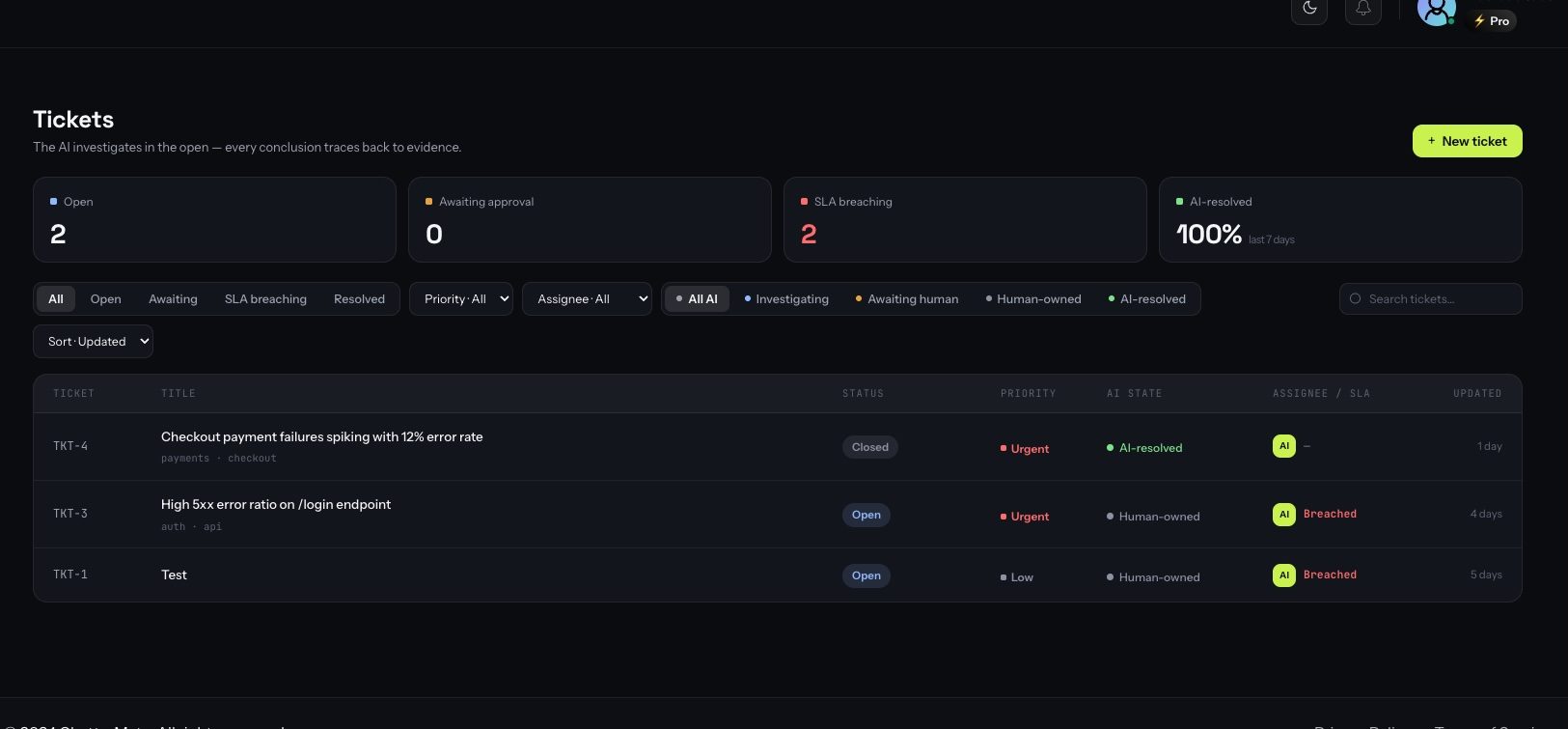
AI Ticketing is a Pro / Enterprise feature. On the community (self-hosted) edition it is fully open.
Where to find it
- Tickets in the main menu — the workspace: list, filters, and every ticket’s detail.
- Ticketing under Settings — autonomy level, SLA targets, customer-message templates, and the investigation connectors.
How tickets are created
From a chat
When the AI can’t resolve a technical issue from the knowledge base, it opens a ticket for the
conversation and links it — the customer keeps chatting normally.
Manually
An agent raises one from the Tickets workspace or straight from a conversation, with an
AI-drafted title and description.
From an alert
A webhook from Grafana, Alertmanager or a generic source auto-creates a ticket and kicks off an
investigation — before a customer even reports it.
The investigation — a glass box
When investigation sources are connected, the AI works the ticket like an on-call engineer, and you watch it happen. It proposes hypotheses, tests each against your tools, marks every one validated / invalidated / inconclusive with a confidence score, and cites the exact query and result behind each conclusion.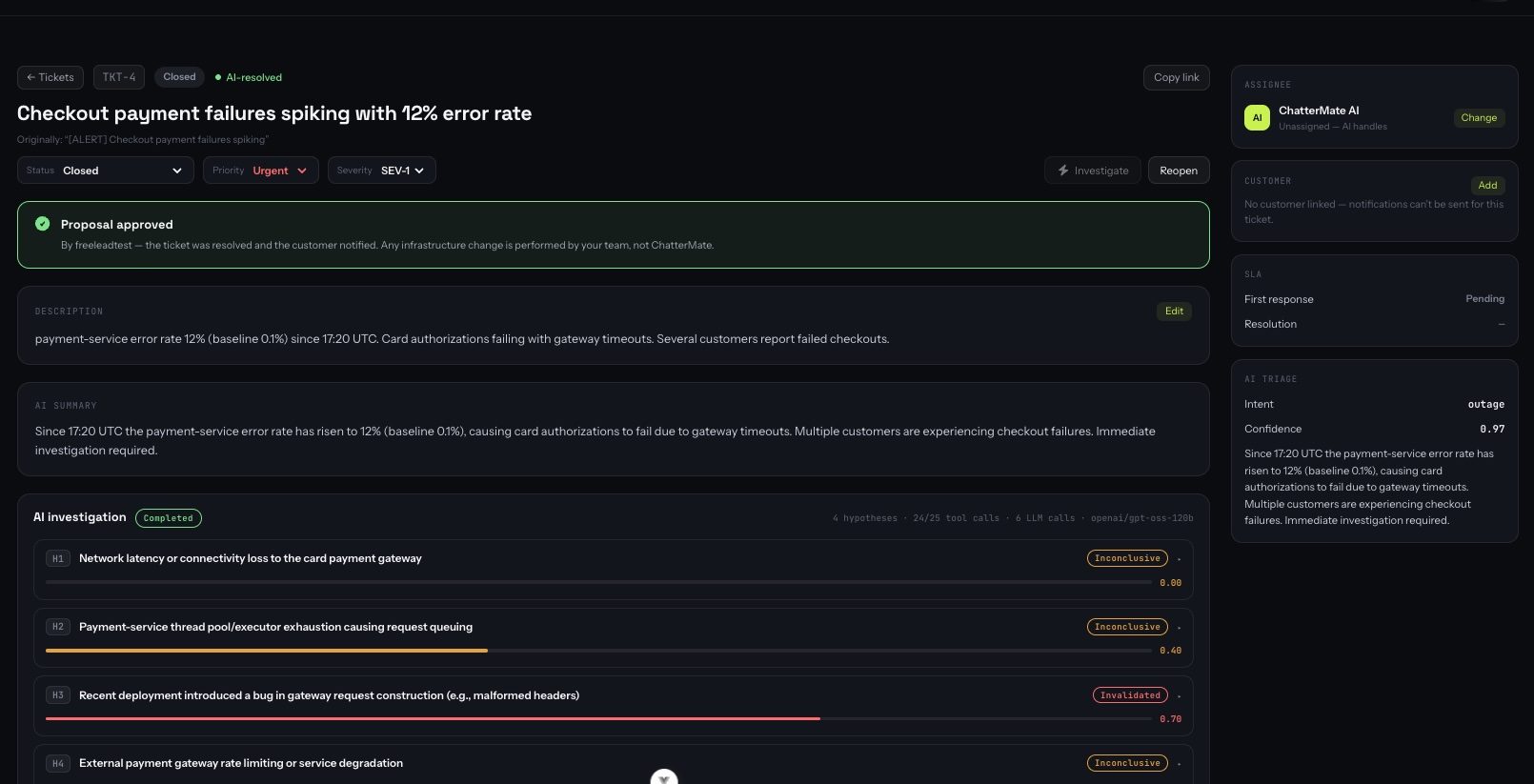
Staged autonomy — you set the ceiling
The AI never exceeds the level you choose, and every level still logs its actions for audit.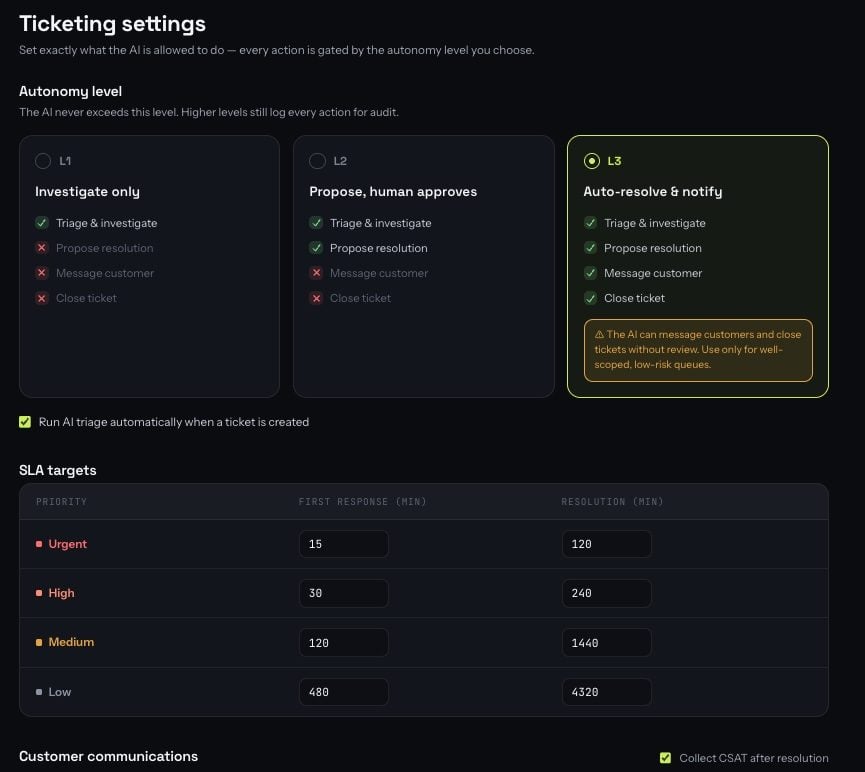
1
L1 — Investigate only
The AI triages, investigates and documents. Every customer message and status change is a human action.
2
L2 — Propose, human approves
The AI also proposes a resolution. A pinned banner shows the proposal and the verification
query behind it; you Approve or Reject with a reason (the reason feeds a refined
investigation). Approving records who and when — ChatterMate never executes an infrastructure change.
3
L3 — Auto-resolve & notify
The AI may also message the customer and close the ticket, behind hard confidence guards. Best
for well-scoped, low-risk queues.
Customer communications
Ticket-created and ticket-resolved messages use editable templates with[customer] and [ticket]
placeholders and a live preview, so customers hear from you in your own voice. You can collect CSAT
after resolution, and auto-close a resolved ticket after a set number of hours without a reply.
Customer emails are sent from your connected email inbox — connect one under Integrations to
send from your own domain; otherwise ChatterMate’s address is used.
Connecting investigation sources
Under Settings → Ticketing, attach read-only sources for the investigation agent (they never touch the customer-facing chat agent):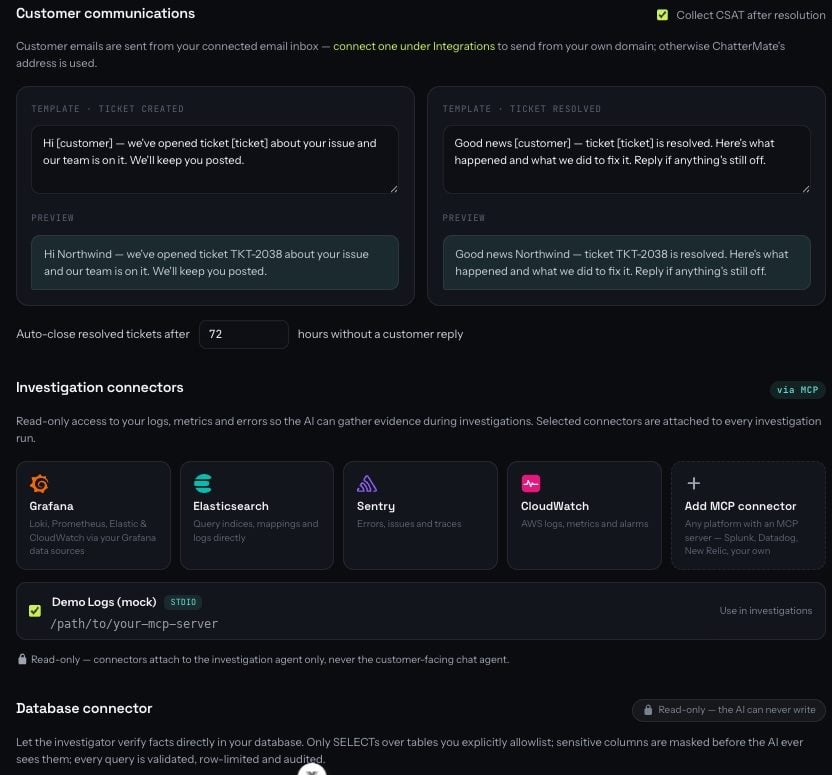
Observability platforms (MCP)
Observability platforms (MCP)
One-click presets for Grafana, Elasticsearch, Sentry and CloudWatch, or any MCP server
(Datadog, Splunk, New Relic, custom) as a generic entry — with encrypted per-org credentials.
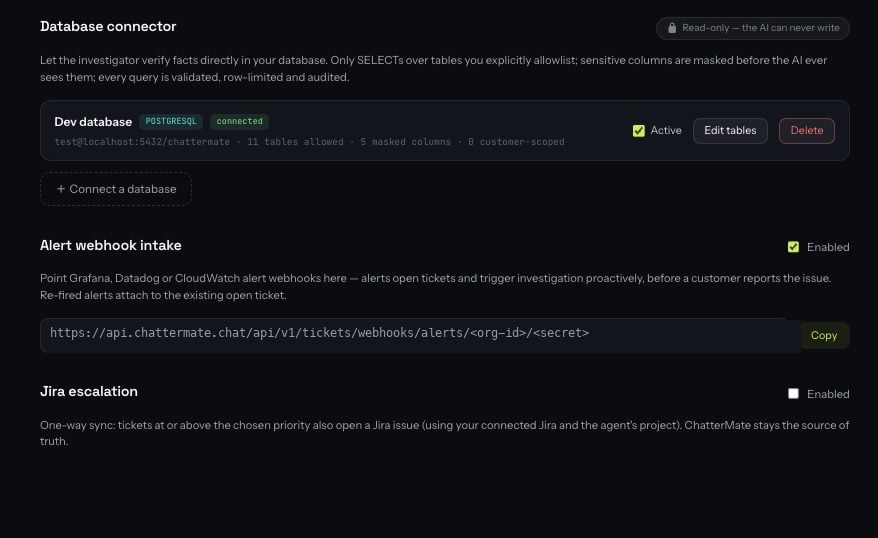
Guardrailed database connector
Guardrailed database connector
Connect a Postgres or MySQL database — directly, or over an SSH tunnel for production
databases behind a bastion. Pick exactly which tables the AI may read, mask sensitive columns,
and optionally restrict a table to the ticket customer’s own rows.
Database guardrails
The investigation agent reads untrusted customer text while holding live tool access, so the limits are enforced in code, not by prompting:- Read-only, structurally. Queries are parsed to an AST and rejected unless they’re a single
plain
SELECTagainst an allowlisted table, with a forcedLIMIT. The connection itself is a read-only transaction with a statement timeout — a second, independent barrier. - Masked columns are never readable — blocked even in a
WHEREclause, so values can’t be probed, and whole-row tricks are blocked too. - Row-level scoping rewrites a query to return only the ticket customer’s own rows — the AI can’t widen it.
- Nothing is ever written to your database; approving a proposal only records the decision.
- Every query is audited with its SQL and outcome; returned rows are never stored.